
Brown County Court Records After Arrest
A Brown County jail booking is a custody record. Court records after a jail arrest are created through the district court process once charges are filed, a warrant case is revived, a probation-violation case moves forward, or another court order drives custody. The research identifies Brown County District Court at the Brown County Courthouse in Hiawatha and the 22nd Judicial District as the local district court structure for Brown, Doniphan, Marshall, and Nemaha counties.
The Brown County Attorney's Office is the local prosecutor's office. The county courthouse directory lists County Attorney Kevin Hill, phone 785-740-7401, and fax 785-740-7403. The prosecutor reviews law-enforcement reports and decides what formal charges, if any, should be filed. A roster entry may show arrest charges or hold text before the final court filing appears, so Brown County jail inmate records and court records must be read as related but separate records.
Find Brown County Court Records After Arrest
Kansas CaseSearch is the statewide district court search portal for public case lookup. Search result text from official Kansas court records pages says CaseSearch supports searching by case number, party name, business name, citation, or other criteria available for a user's role. If a public record is not available online, Kansas court materials indicate it may still be available at the courthouse or through the clerk's office, subject to access rules.
- Use the Brown County jail roster to capture the defendant name, booking date, arresting agency, and listed booking charges.
- Search Kansas CaseSearch by party name, or use case number or citation if known.
- Open the district court case result and compare filed charges with the roster charge text.
- Review hearing dates, bond orders, charge status, disposition, and sentencing entries when public.
- If the case is missing online, contact or visit the Brown County District Court clerk at the courthouse.
The Kansas CaseSearch portal is the official statewide search page used for district court case lookup after a Brown County arrest.
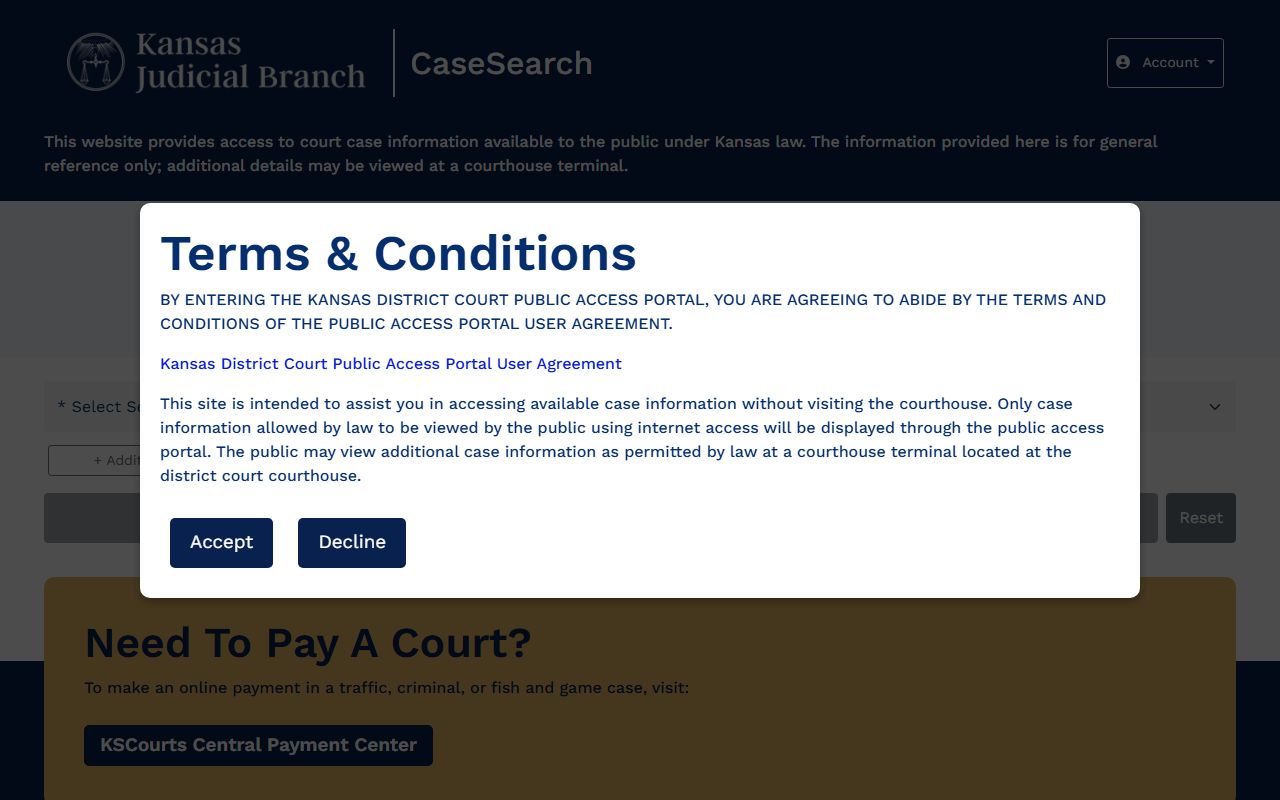
The screenshot matters because it points readers away from the jail roster when the question is filed charges, court dates, and case status.
Brown County Court Record Search Fields
Kansas CaseSearch is broader than the Brown County roster. A person can search by party name when only the defendant's name is known, or by case number or citation when paperwork has already been issued. Role-based criteria may differ. Brown County court records after arrest can also be checked at the courthouse when online access does not show the record or when the case has access limits.
| Field Label | Type | Required | Notes |
|---|---|---|---|
| Case number | Text | Optional search path | Use when court paperwork or docket data provides the number. |
| Party name | Text | Optional search path | Use defendant last and first name for criminal cases. |
| Business name | Text | Optional | More common for civil or business-party searches. |
| Citation | Text | Optional | Useful for traffic or ordinance matters. |
| Role-based criteria | Varies | Role-dependent | Expanded access may require account or identity steps. |
Charges Filed After Arrest
After a Brown County jail arrest, the charging document is the bridge from custody to the court record. The research identifies common terms that readers may see across jail and court records: complaint, information, and indictment. Local cases will not all use each type. The key point is that the filed court charge may differ from the booking text that first appears on the jail roster.
| Document | Filed By | Plain Meaning |
|---|---|---|
| Complaint | Often officer or prosecutor | A charging document often used to start a criminal case. |
| Information | Prosecutor | A formal charge filed by the prosecutor, often used in felony procedure. |
| Indictment | Grand jury | A grand-jury charging document, less common in routine local cases. |
Brown County Charge Status
Court records after arrest should be checked for status, not just charge title. A roster entry might list failure to appear, probation violation, driving while suspended, marijuana possession, criminal threat, or tribal courtesy detention text. The court file is where the filed charge, amendment, dismissal, plea, disposition, or sentence is tracked. The roster does not prove conviction.
| Status | What It Means |
|---|---|
| Pending | The charge or case remains open and has not reached final disposition. |
| Amended | The prosecutor or court changed the charge from an earlier version. |
| Dismissed | The charge was ended without a conviction on that charge. |
| Convicted | A plea or verdict resulted in a conviction. |
| Probation violation | The case concerns alleged violation of probation terms rather than only a new arrest charge. |
Bond After Brown County Arrest
The Brown County roster shows numeric bond amounts, but the capture did not expose bond type. Examples included 0, 1000, 3000, 19800, 25500, 27500, 27894, and 50000. A zero shown on the roster should not be interpreted without jail or court confirmation. It might reflect no bond, a hold, not-yet-set status, or another local data meaning that the roster does not define.
| Bond Type | Practical Meaning |
|---|---|
| Cash bond | Money is paid directly to satisfy the court-set amount. |
| Surety bond | A licensed bail agent posts bond under a fee or collateral arrangement. |
| Personal recognizance | The court releases the person on a promise to appear and follow conditions. |
| No-bond or hold | Posting money alone will not release the person due to a warrant, hold, or court order. |
Brown County publishes an approved bail-bond agency list. Confirm bond status with the jail or court before paying, and check whether another agency, tribal court, state DOC, federal court, or ICE hold affects release.
Warrants and Court Records
The Brown County Sheriff's Office also publishes an official outstanding warrants page with a Name search field and paginated warrant entries. A warrant listing can lead to arrest, booking into the Brown County Jail, and later court action. It does not prove current custody by itself. The roster must be checked separately for current jail status, and Kansas CaseSearch should be used for the underlying court case when one is filed or already active.
Observed warrant entries included warrant numbers, charge text, bond fields, date, age, sex, and race. Examples of charge text in the warrant inventory included failure to appear, traffic offenses, criminal threat, fraud or insufficient funds check, and possession charges. For routine warrant checks, use the sheriff's non-emergency number, not 911, unless there is an emergency.
Charges vs Convictions
Court records after a jail arrest often contain accusations before they contain outcomes. A charge means the state or court is alleging an offense or processing a violation. A conviction means a guilty plea, finding, or verdict resolved the charge that way. The distinction matters for Brown County because the jail roster may show arrest or hold text long before the court record reaches a final result.
| Point | Charge | Conviction |
|---|---|---|
| Stage | Accusation or alleged violation | Final or resolved finding on that charge |
| Where seen | Jail roster and early court filings | Court disposition and, if sentenced to KDOC, KASPER records |
| Can change | Yes, charges may be amended, dropped, or added | Changes usually require appeal, expungement, or other court action |
Sealed Expunged Arrest Records
Access to Brown County court records after an arrest can be limited by Kansas court rules, the Kansas Open Records Act, juvenile protections, sealed records, and expungement. K.S.A. 21-6614 is the Kansas expungement statute identified in the research for certain convictions, arrest records, and diversion agreements. Expungement is a court process, not a jail website removal request.
| Point | Sealed or Restricted | Expunged |
|---|---|---|
| Public access | Limited or hidden from public view under a court rule or order | Restricted after the court grants qualifying relief |
| Where to act | Through the court that controls the file | Through the statutory expungement process |
| What it affects | Case access, documents, or protected details | Eligible arrest, conviction, or diversion records under Kansas law |
Restricted Court Records After Arrest
Kansas public-record rules do not mean every criminal justice record is open online. K.S.A. 45-221 lists categories that may be closed, including certain criminal investigation records and privacy-sensitive records. Court access rules can also limit juvenile, sealed, expunged, protected, or otherwise restricted case information. A missing online result should be checked with the clerk before assuming no case exists.
Important: Casual public lookup is not a Fair Credit Reporting Act background check and must not be used for FCRA-covered decisions.
Public Record Search
Sponsored Results